


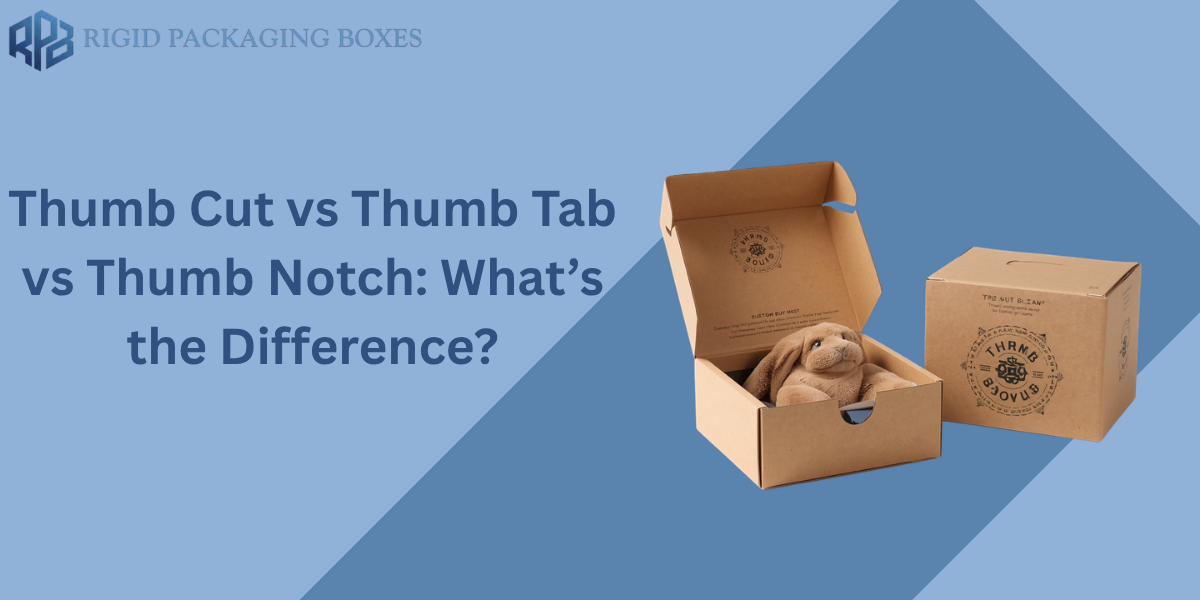
Ever opened a box and thought, “Why does this one feel easy, and that one feels awkward?” That tiny cut on the edge often decides it. And this is where people get confused.
They hear thumb cut, thumb tab, and thumb notch and assume all three mean the same thing. Not always. They can overlap. Some suppliers even use them loosely. But in real packaging work, the difference matters. It affects how the box opens, how it locks, how premium it feels, and even how your product is perceived.
Why Most People Get This Wrong
From a distance, all three sound like “that little thumb space on a box.” That is the trap.
A lot of sellers and packaging sites describe these features in slightly different ways. Some use a thumb tab for a simple opening cutout. Others use a thumb tab for a locking tab on a mailer-style box. Packaging references commonly describe thumb tabs as cutouts for easier opening, while other sources describe thumb tab boxes as locking mailer boxes. Thumb notch is also described as a cut-out that helps access or open the box.
That means one word can lead to two different box styles. So the smart move is not to rely on the name alone. Rely on the shape and the function.
Let’s Make It Simple
Here is the easiest way to think about it:
- Thumb cut = a cut-out area where your thumb goes
- Thumb notch = usually the same idea, just another name for that cut-out
- Thumb tab = sometimes used for the same cut-out, but sometimes it means an actual tab that locks the lid
That is the real-world answer, not the neat textbook answer, and that is the part most blogs skip.
Thumb Cut: The Easy Grab Feature
A thumb cut is usually a small curved cut-out on the front edge, side edge, or inner tray of a box. Its job is simple. It gives your finger space to push, pull, or lift.
Think about a drawer-style box for jewelry. You slide the inner tray out using that half-moon cut. That is a classic thumb cut. Think about a gift card sleeve. Same idea. Think about a phone accessory box with a tray inside. Again, same idea.
A packaging source describes a thumb cut box as having a small semicircular or crescent-shaped cutout along the edge to create a natural place for fingers to grip, and another source notes that thumb cuts are standard die-cut features used on different packaging materials.
When a thumb cut works best
Use it when:
- The product sits in a tray or sleeve
- The customer needs quick access
- You want a neat, minimal opening style
- You do not want extra flaps or locking parts
Why brands like it
Because it feels clean. No extra drama. No confusing opening steps. It tells the customer, “Open here,” without printing instructions all over the box.
Practical tip
If your product is premium, make sure the thumb cut is smooth and deep enough to grip easily. A bad thumb cut is worse than no thumb cut. Too shallow, and people struggle. Too sharp, and it feels cheap.
Thumb Notch: Same Family, Slightly Different Label
Now let’s talk about thumb notch. In many packaging jobs, thumb notch means almost the same thing as thumb cut.
A packaging library defines a thumb notch as a cut-out in a panel that helps with access or opening. Another packaging reference describes a thumb hole as a semicircle cut that makes opening easier.
So what is the difference? Usually, it is more about language than structure. Some teams say thumb cut. Some say thumb notch. Some use one term for rigid boxes and another for folding cartons. But visually, they often point to that same half-moon or curved opening area.
A simple analogy
Think of it like “sofa” and “couch.” Different word. Same thing most of the time.
Where the thumb notch is common
You will often hear it in:
- folding cartons
- sleeves
- rigid box trays
- display packaging
- insert access points
Practical tip
When talking to a supplier, do not just say, “I want a thumb notch.” Say this instead:
“I want a half-moon cut-out on the front edge for easy opening.”
Now there is no confusion. That one sentence can save you three rounds of corrections.
Thumb Tab: This Is Where Things Get Messy
This one causes the most confusion. Why? Because thumb tab is used in two different ways.
Meaning 1: A cutout for your thumb
Some packaging sources describe thumb tabs as circular cutouts on the main panels that help open the box more easily. In that usage, thumb tab sounds very close to thumb cut or thumb notch. No big difference.
Meaning 2: A real tab that locks the box
Other packaging sources use thumb tab to describe a die-cut mailer box with a front tab that locks into a slot in the lid.
That is a totally different thing. Now you are not talking about just a finger cutout. You are talking about a structural locking feature. And that changes everything.
Real-world example
Imagine you order packaging for skincare samples. You ask for a “thumb tab.” You are thinking of a nice, curved finger opening. Your supplier is thinking of a locking mailer box. Now the sample box arrives bulky, overbuilt, and wrong for retail display. That mistake happens more than people admit.
Practical tip
If you mean a locking feature, say: “A front locking tab mailer box.”
If you mean a finger opening, say: “A thumb cut-out” or “half-moon notch.”
Clear beats clever. Always.
The Fastest Way to Spot the Difference
Here is the easiest test. Ask one question:
Is this feature meant to help me grip the box, or to lock the box?
If it helps you grip it, you are probably dealing with a thumb cut or thumb notch. If it locks the lid in place, you are probably dealing with a thumb tab in the structural sense. That one question clears up most confusion.
What Nobody Tells You
Most guides explain the shape. They do not explain the buying problem. Here it is:
- The biggest issue is not design. It is a naming inconsistency.
- That is why people approve the wrong dieline.
- That is why samples come back wrong.
- That is why teams waste time in back-and-forth emails.
In packaging, words are often fuzzy. Drawings are not. So do this every time:
- Ask for a mockup
- Ask for a dieline
- Circle the exact area you mean
- Label it by function, not just by name
This matters even more when working with a new supplier or a large product line.
At Rigid Packaging Boxes, or with any custom packaging vendor, the safest route is always visual confirmation before production.
Which One Should You Choose?
That depends on the job.
Choose thumb cut if…
- You want a clean, premium opening
- Your box has a tray or sleeve
- You want the customer to access the product fast
- Your design is minimal and elegant
This works well for cosmetics, tech accessories, invitation boxes, gift sets, and premium stationery.
Choose thumb notch if…
- Your supplier uses that term instead of thumb cut
- You want the same easy finger access
- Your box structure is simple and functional
This is often less about a different feature and more about wording.
Choose thumb tab if…
- You need a locking box
- You are shipping the product
- You want the lid to stay secure
- You are using a mailer-style structure
This is common for subscription kits, ecommerce packaging, small mailers, and product kits.
A Quick Comparison You’ll Actually Remember
Picture three situations.
- A drawer: You pull it open with your finger. That is thumb cut territory.
- A curved bite taken out of the edge: That is usually a thumb notch.
- A jacket button: It holds things closed. That is the thumb tab locking version.
Easy, now you can remember it without memorizing packaging jargon.
Common Mistakes Brands Make
Asking for a term without showing the shape: Never trust the word alone.
Making the cutout too small: Looks nice on screen. Feels annoying in hand.
Ignoring user experience: A box is not just for protection. It is part of the product experience.
Choosing style over practicality: A super sleek box that is hard to open does not feel premium. It feels frustrating.
Forgetting the product weight: If the product is heavy, a tiny notch may not be enough. You may need a stronger opening system or a different structure.
How to Brief Your Packaging Supplier the Right Way
Box style: sleeve, tray, mailer, rigid box, folding carton
Opening feature: half-moon thumb cut / panel notch / locking front tab
Location: front center, side edge, tray lip
Purpose: easy pull, easy grip, secure lock
Reference: attach photo or mark dieline
That one small process makes you look experienced. Even if this is your first packaging project.
Final Take
Here is the clean answer. Thumb cut and thumb notch usually mean the same kind of thing: a cut-out made for easy finger access. Thumb tab can mean that too in some cases. But in many packaging conversations, it can also mean a real locking tab on a mailer-style box.
That is why people get confused. So do not ask only for the name.
- Ask for the function.
- Ask for the shape.
- Ask for the exact placement.
That is how you avoid mistakes and get packaging that feels good in the customer’s hand. And honestly, that tiny detail can change the whole unboxing experience.